Last checked
Key facts
- Duration
- 10 days from Pokhara and back
- Highest point
- 4,130 m (13,550 ft) at Annapurna Base Camp
- Total distance
- 110 km
- Difficulty
- Moderate, 2 of 5
- Best months
- March to April and October to December
- Months to avoid
- June to August
- Starts and ends
- Nayapul or Jhinu Danda, near Pokhara to Pokhara
- Accommodation
- Teahouse lodges
- Permits
- Annapurna Conservation Area Permit (ACAP)
- Typical cost
- $650 to $1,200 per person, guided
- Experience needed
- None. This is the route most people should do before attempting anything in the Khumbu.
Why choose Annapurna Base Camp over Everest Base Camp?
It is shorter, cheaper, lower and needs no mountain flight, and it puts you inside a complete ring of Himalayan giants rather than at the foot of one. For a first trek in Nepal it is the better choice on almost every measure except bragging rights.
Ten days against fourteen, and 4,130 m against 5,545 m, which removes most of the altitude risk that turns people back in the Khumbu.
There is no Lukla flight, so there is no weather lottery and no two contingency days. You drive from Pokhara and you start walking.
The scenery is different rather than lesser. Everest gives you scale and rock. The Annapurna Sanctuary gives you a closed amphitheatre where the peaks surround the lodge you are standing outside.
How hard is the Annapurna Base Camp trek?
Moderate. The daily distances are manageable and the altitude is low enough that acute mountain sickness is uncommon, but the route is built almost entirely from stone staircases and that is harder on the body than it sounds.
The Chhomrong stairs, around 400 steps down and then back up on the return, are the single feature everyone remembers.
Descent is where people get hurt. Trekking poles and a slow pace on the way down matter more here than fitness on the way up.
At 4,130 m a minority of trekkers get a headache at Base Camp. The itinerary's short fifth day exists to prevent it.
When is the best time to trek to Annapurna Base Camp?
October to early December and March to April. Autumn brings clear, stable skies after the monsoon, while spring adds rhododendron blooms through the middle section of the route. Avoid June to August, when the gorge is wet, leech-ridden and closed in.
December is underrated here. It is cold at Base Camp but the air is exceptionally clear and the trail is quiet.
Avalanche risk in the Deurali to Machhapuchhre Base Camp section rises after heavy snow, usually late winter. A local guide reads this far better than a forecast.
The monsoon closes the views entirely and turns the stone steps into a slip hazard. There is no good reason to walk this route in July.
| Season | Months | Conditions | Crowds |
|---|---|---|---|
| Autumn | October to early December | Clearest skies, cold nights at Base Camp | High |
| Spring | March to April | Rhododendrons, warmer, more haze | High |
| Monsoon | June to August | Rain, leeches, no views, slippery steps | Very low |
| Winter | January to February | Clear and quiet, snow and avalanche risk high up | Low |
How much does the Annapurna Base Camp trek cost?
A guided 10 day trek with a Nepal-based operator runs 650 to 1,200 USD per person including guide, porter, permit, teahouse lodging and all trail meals. There is no expensive mountain flight, which is why it undercuts Everest Base Camp by roughly half.
The ACAP permit is 3,000 NPR for foreign nationals and 1,000 NPR for SAARC nationals. Buy it in Pokhara, because the checkpost price is double.
Budget 10 to 20 USD a day on top for charging, hot showers, WiFi and anything outside the set menu.
There are no ATMs past Pokhara, so draw the full trek's cash there.
What are the route variations?
You can add Poon Hill for a sunrise viewpoint, start from Kande via Australian Camp for a gentler opening, or route out through Ghandruk for a fuller village experience. Each adds one to two days.
Poon Hill, added at the start, gives a well-known dawn panorama of both Annapurna and Dhaulagiri for one extra day of walking.
Ghandruk on the return is the more interesting way out. It is a large, handsome Gurung village with a museum and it beats retracing the river trail.
Shortening below eight trail days means skipping the sanctuary approach, which is the part worth coming for. Do not cut it.
Annapurna Base Camp Trek itinerary, day by day
The full 10 day schedule, with sleeping altitude, walking hours and overnight stop for every day. The acclimatisation days are the ones that decide whether people finish.
Day 1
Pokhara to Jhinu Danda
- 1,780 m
- Up 960 m
- 7 km
- 2 to 3 h
- Sleep: Jhinu Danda
A short drive out of the Pokhara valley and a gentle first afternoon along the Modi Khola.
Read the dayShow less
The road to the trailhead is rough and the jeep ride is the least comfortable part of the whole trek.
Hot springs sit twenty minutes below Jhinu Danda on the riverbank. Go on the way back rather than on day one.
Transport: 2 hour drive to the trailhead
Highlight: Riverside hot springs
Day 2
Jhinu Danda to Chhomrong
- 2,170 m
- Up 390 m
- 9.5 km
- 5 h
- Sleep: Chhomrong
Through Gurung villages and terraced fields to the last permanent settlement before the sanctuary.
Read the dayShow less
Chhomrong is the gateway village and the last place with a bakery, a shop and reliable phone signal.
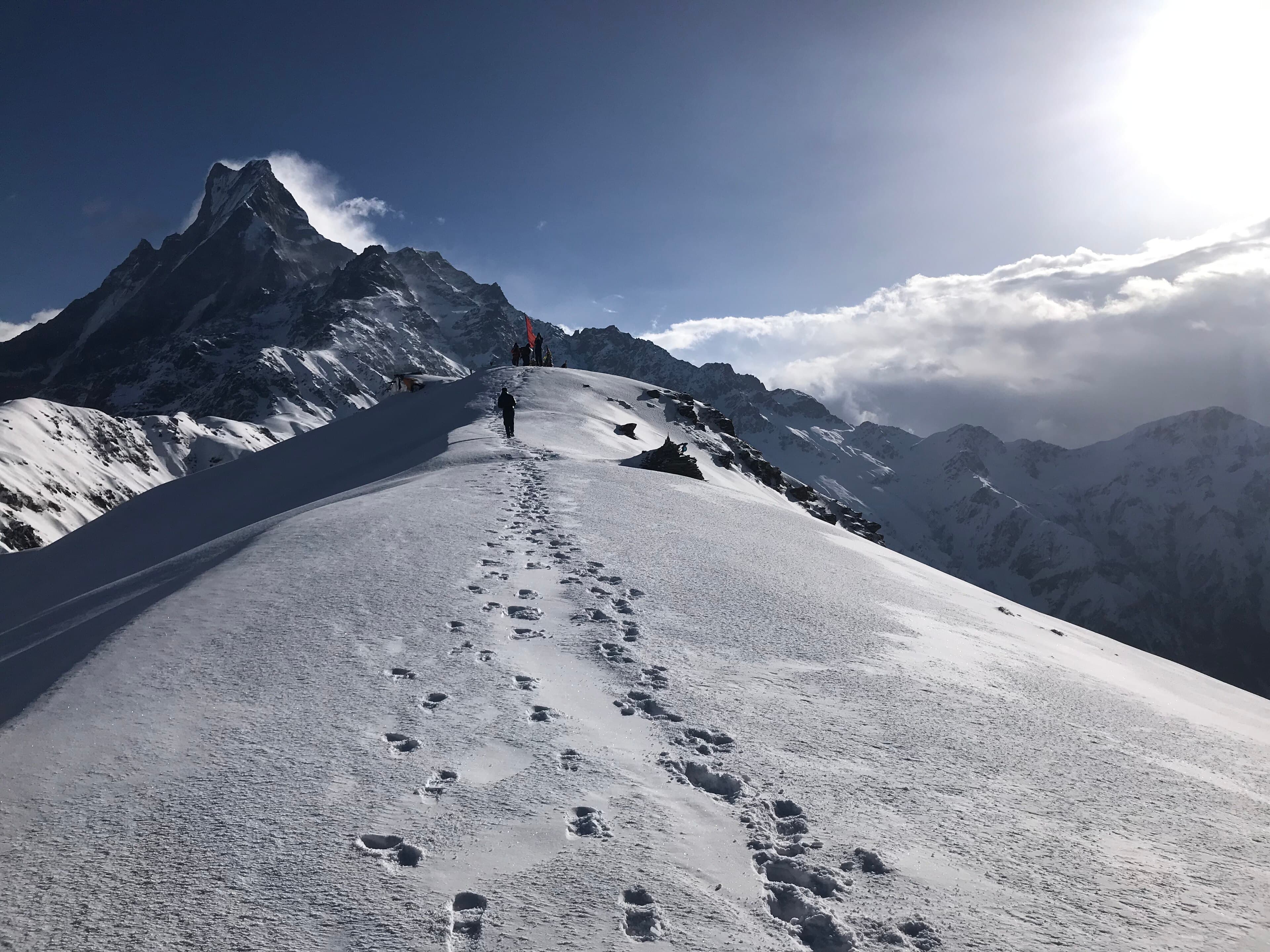
Machhapuchhre stands directly above the village and is the reason nobody leaves the terrace at sunset.
Highlight: Machhapuchhre from the Chhomrong terrace
Day 3
Chhomrong to Dovan
- 2,600 m
- Up 430 m
- 11 km
- 6 h
- Sleep: Dovan
Down the infamous Chhomrong stairs, then a long climb through bamboo and rhododendron into the gorge.
Read the dayShow less
The descent out of Chhomrong is 400 stone steps and you will climb every one of them on the way home.
From Bamboo upward the valley narrows into a damp, green corridor with leeches after rain and almost no view.
Day 4
Dovan to Machhapuchhre Base Camp
- 3,700 m
- Up 1,100 m
- 9 km
- 5 to 6 h
- Sleep: Machhapuchhre Base Camp
The gorge opens without warning and the sanctuary reveals itself. The largest single climb of the trek.
Read the dayShow less
Past the Hinku Cave and the Deurali avalanche section, which your guide will want to cross early in the day.
The moment the walls fall away above Deurali is the best thirty seconds on the route.
Highlight: Entering the Annapurna Sanctuary
Day 5
Machhapuchhre Base Camp to Annapurna Base Camp
- 4,130 m
- Up 430 m
- 5 km
- 2 h
- Sleep: Annapurna Base Camp
A short, slow walk into the amphitheatre, then a full afternoon and a sunrise inside a ring of eight thousand metre peaks.
Read the dayShow less
Deliberately short so you arrive with the whole day ahead of you. Go up in the morning, rest, walk the moraine in the afternoon.
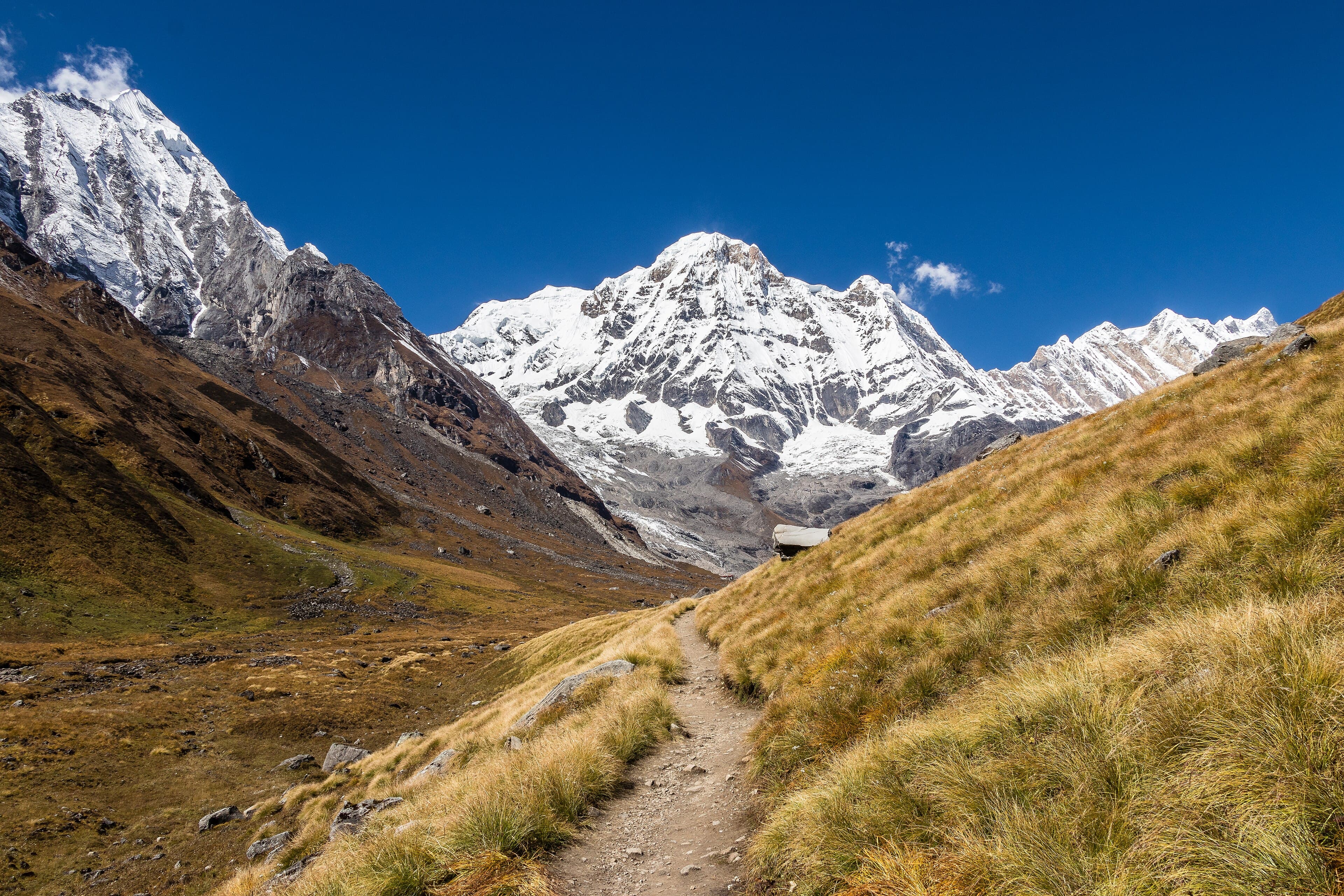
Annapurna I, Annapurna South, Hiunchuli, Gangapurna and Machhapuchhre form a near complete circle around the lodges.
Sunrise here needs no climb. You watch it from outside the dining room door.
Highlight: Sunrise inside the sanctuary
Day 6
Annapurna Base Camp to Bamboo
- 2,310 m
- Down 1,820 m
- 15 km
- 6 to 7 h
- Sleep: Bamboo
A long descent back through the gorge, losing most of the altitude you spent four days gaining.
Read the dayShow less
Poles help enormously here. The knees take a beating on the steeper sections below Deurali.
Day 7
Bamboo to Jhinu Danda
- 1,780 m
- Down 530 m
- 13 km
- 6 h
- Sleep: Jhinu Danda
Back up the Chhomrong stairs, over the ridge and down to the river for the hot springs.
Read the dayShow less
The Chhomrong climb is the hardest hour of the return leg and it comes early in the day, which is the mercy.
Twenty minutes below the lodges there are stone pools fed by a hot spring. Ten days of walking end well here.
Highlight: Jhinu Danda hot springs
Day 8
Jhinu Danda to Pokhara
- 820 m
- Down 960 m
- 5 km
- 2 h
- Sleep: Pokhara
A short walk out to the road and back to lakeside Pokhara by early afternoon.
Read the dayShow less
Pokhara is the best reward town in Nepal. Lakeside, a boat on Phewa Tal, and food that is not dal bhat.
Transport: 2 hour jeep to Pokhara
Day 9, acclimatisation
Pokhara rest day
- 820 m
- Rest day
- Sleep: Pokhara
A free day by the lake, or the buffer if the trail took longer than planned.
Read the dayShow less
Sarangkot at dawn for the Annapurna panorama from the other side, or paragliding off the same ridge.
Day 10
Pokhara to Kathmandu
- 1,400 m
- Up 580 m
- Sleep: Departure
Fly or drive back to Kathmandu.
Read the dayShow less
The flight is 25 minutes and cheap. The road is seven hours on a good day and considerably longer on a bad one.
Transport: 25 minute flight or 7 hour drive
What is included and what is not
Long staircase days rather than thin air. The altitude stays low enough that acclimatisation is rarely the limiting factor, but the stone steps above Chhomrong punish unprepared knees.
Included in a guided price
Pokhara transfers
Airport pickup and the jeep to and from the trailhead.
Accommodation
Two nights in Pokhara and seven teahouse nights on a twin share basis.
All meals on trek
Breakfast, lunch and dinner from the lodge menu for every trail day.
Licensed guide
Government-licensed English-speaking guide, including wage, insurance, food and lodging.
Porter support
One porter per two trekkers, up to 20 kg total.
ACAP permit
Annapurna Conservation Area Permit arranged in advance.
Not included, budget for it
International flights
To and from Nepal.
Nepal visaabout $50
On arrival, cash in USD.
Travel insurance
Mandatory, with cover to 4,500 m and helicopter evacuation.
Hot showers and chargingabout $2 to 5 per use
Paid separately at the lodges.
Drinks, snacks and WiFi
Anything outside the set menu.
Kathmandu to Pokhara travel
Flight or tourist bus, arranged on request.
Tips
Customary for the guide and porters.
Permits for the Annapurna Base Camp Trek
Annapurna Conservation Area Permit (ACAP)
Issued by National Trust for Nature Conservation
- Foreign
- NPR 3,000
- SAARC
- NPR 1,000
Buy in Kathmandu or Pokhara before you start. Buying it at the checkpost costs double.
What to pack
You need the legs for five to six hours of steps a day. There is very little flat ground on this route in either direction.
Upper body
- Two base layer tops
- Fleece midlayer
- Light down jacket for the sanctuary nights
- Waterproof shell
- Sun hat and warm beanie
- Light gloves
Lower body
- Two pairs of trekking trousers
- Waterproof overtrousers
- Three pairs of wool socks
Footwear
- Broken-in boots with good tread for wet stone steps
- Camp shoes
Sleep and carry
- Sleeping bag rated to minus 5 C
- 25 to 30 litre daypack with rain cover
- Duffel for the porter
Health and safety
- Trekking poles, genuinely worth it on this route
- Blister kit
- Water purification
- Insect repellent for the lower forest
- SPF 50 sunscreen
- Personal medication
Practical
- Headtorch
- Power bank
- Nepali rupees, since there are no ATMs past Pokhara
- Passport and insurance documents
Frequently asked questions
Sources checked
- ACAP permit feesNational Trust for Nature Conservation, checked 27 September 2026
- Trekking regulationsNepal Tourism Board, checked 27 September 2026
Fees and regulations in Nepal change. This page was last verified on 27 September 2026.